Free Flight autogiro
The autogiros (girocopters)
The first autogiro was built in the year 1923 by the spanish civil engineer Juan de la Cierva.
The principle of the autorotation already existed previously in the nature and we can see it, for example, in the seeds of certain trees of garden. These seeds have the stone on an extreme and a wing in the rest. To|In the to fall down of the tree, they start to turn in a vertical axis around its center of masses (the stone) and at the to acquire relative speed with respect to the air the wing creates sustenance and it balances partially the weight of the stone. Dragged for the wind or for currents upward the seed can travel in autorrotation and without any engine at kilometers of distance...
The acrobats of the paraglide know like making how to enter the hight aspect ratio paragliders in selfrotation, maneuver called normally "helicopter" although really it should name "autogiro". The vertical speed of fall of the maneuver him relatively sick leave, but in paraglide the pilot is subdued in a continuous rotation and a danger of being fold or twist, that can not keep for much of time.
This principle has been applied with success to autogiros with engine, that provistos with a horizontal propulsion can move with facility with or without wind, being the main rotor turning completely free in selfrotation and without any transmission of the engine. It is necessary to clarify that the autogiros whith engine have a small transmission of force from the main engine to the main rotor only in the phase of being started off, for giving angular speed to the blades until acquires the revolutions per minute necessary for the takeoff. This transmission (pre-rotator) is optional and some light aircraft autogiros simple they are prelaunched giving an initial impulse to the rotor blades with the hands and waiting that the relative wind, or acquired with the career, give the necessary revolutions for takeoff.
Difference
with the helicopters
The helicopters to advance towards ahead need to incline the plan of the main rotor under the horizontal, to create one quite that promotes towards ahead taking the air of above to down with the help of an engine to the main rotor. It would not be possible to make a helicopter for flight free. However the autogiros fly normally with the plan of the rotor with an angle above the horizontal so that the one that sustains the movement of the blades is the air that hits under the rotor. It is necessary to say that the helicopters have a security system that in the event of stop of engine disconnects the main transmission, it invests the angle of incidence of the blades (without investing the sense of the rotation) and it makes enter in autorotation allowing a safety landing.
Autogiros for free flight
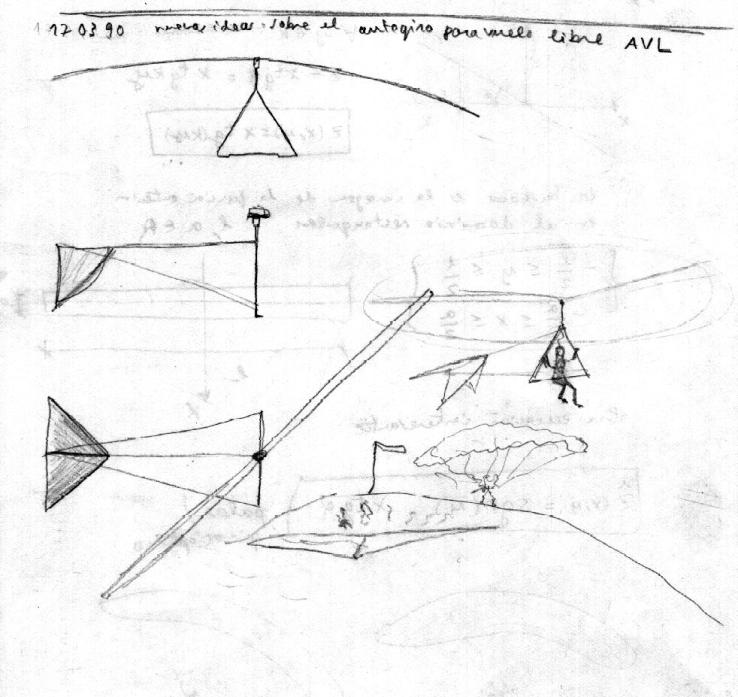
Is the observation of the functioning of the light aircraft autogiros at the beginning of the 90, in particular of the model Mach-10 of Sallén Aviación the one that led me to be thought that... because not to eliminate the engine and frame and replace it for a triangle and a keel of delta wing?. Its known that the advantage of the light aircraft autogiro it is that in the event of stop of engine they continue in selfrotation, as a matter of fact, with the engine at minimum power him almost as if they did not have propulsion. So the idea about a autogiro of free flight appears with relative naturalness.
See a primitive idea about 1990 here
about this:
Autogiro Nitsch
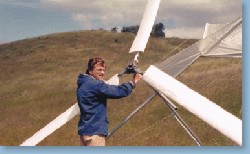
Years afterwards I have contacted the designer Stephan Nitsch, specialist in the reproduction of the rigid wings of the Otto Lilienthal, which was experimenting towards 1983 with an autogiro prototype at real scale as it is detailed in their web page. On his web page there are a detailed explanatory pdf document and a video of the experiments carried out.
Autogiro Nitsch
Morozov
rotorplane and others
"rotorplane" from Vitaliy.S.Morozov (link lost)
"rotorplane" from Vitaliy.S.Morozov (link lost)
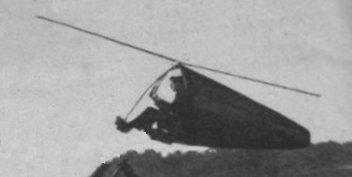
The idea of him is similar to the Autogiro Nitsch, but with design bishovel nowhere in trishovel. The advantage him that foreseen tea a system prestriker with rockets on the tips of the wings (optional system to initiate the rotation into the case that there is not wind) and it seems that at the rotor has a mechanism to vary, him to say the incidence of the shovels. The structure seems ideated to protect the pilot of the shovels, and these seem high enough like to avoid contacts with the floor. The system of takeoff, wants and landing him similar to that of a hang glider. Now, with a autogiro, the great advantage of the autogiro is not entering in stall, since the wings continue turning with respect to the wind.
The photos of a prototype of 1984 are seen. In the text is indicated that the performance of the device him similar to that of a hang glider, but it is necessary to consider that it is related at the beginning of the 80. And it is necessary to consider that due to the big resistance that offers the rotor they can not achieve themselves with facility high glide angles.
Autogiro Fa-330 [ru]
Others: http://twistairclub.narod.ru/kits/tales.htm
The idea about autogiro of free flight is theoretically possible but it still needs to develop.
That one who knows if some day we will change our paragliders for a selfturning of free flight!
As a matter of fact, the idea about the autogiro of free flight him very ancient, you see the Hafner "Rotachute". It is a kind of rotatory parachute to jump of the airplanes. Photo of 1940, slightly retouched by LE: